The Good and the Bad of Automated Home Value Tools
Automated home value tools have become one of the most popular features of real estate websites, giving homeowners and buyers instant estimates with a single search. Platforms like Zillow’s Zestimate, Redfin’s Estimate, and Realtor.com’s home value tool put a number on any property in seconds — and millions of people rely on them every day. But how accurate are these tools, really? And what happens when you make a major financial decision based on a number that might be significantly off? Here’s an honest breakdown of what automated home value tools get right, where they fall short, and how to use them wisely.
Find Your Home’s Current Value Here!
What Are Automated Home Value Tools?
Automated home value tools — sometimes called AVMs, or Automated Valuation Models — use algorithms to estimate a property’s market value. They pull data from public records, tax assessments, recent sales, and listing information to generate an estimated value without anyone ever stepping foot inside the home.
The most well-known example is Zillow’s Zestimate, but nearly every major real estate platform now offers its own version. These tools are free, fast, and available 24/7 — which explains their enormous popularity. But as with most shortcuts, convenience comes with trade-offs.
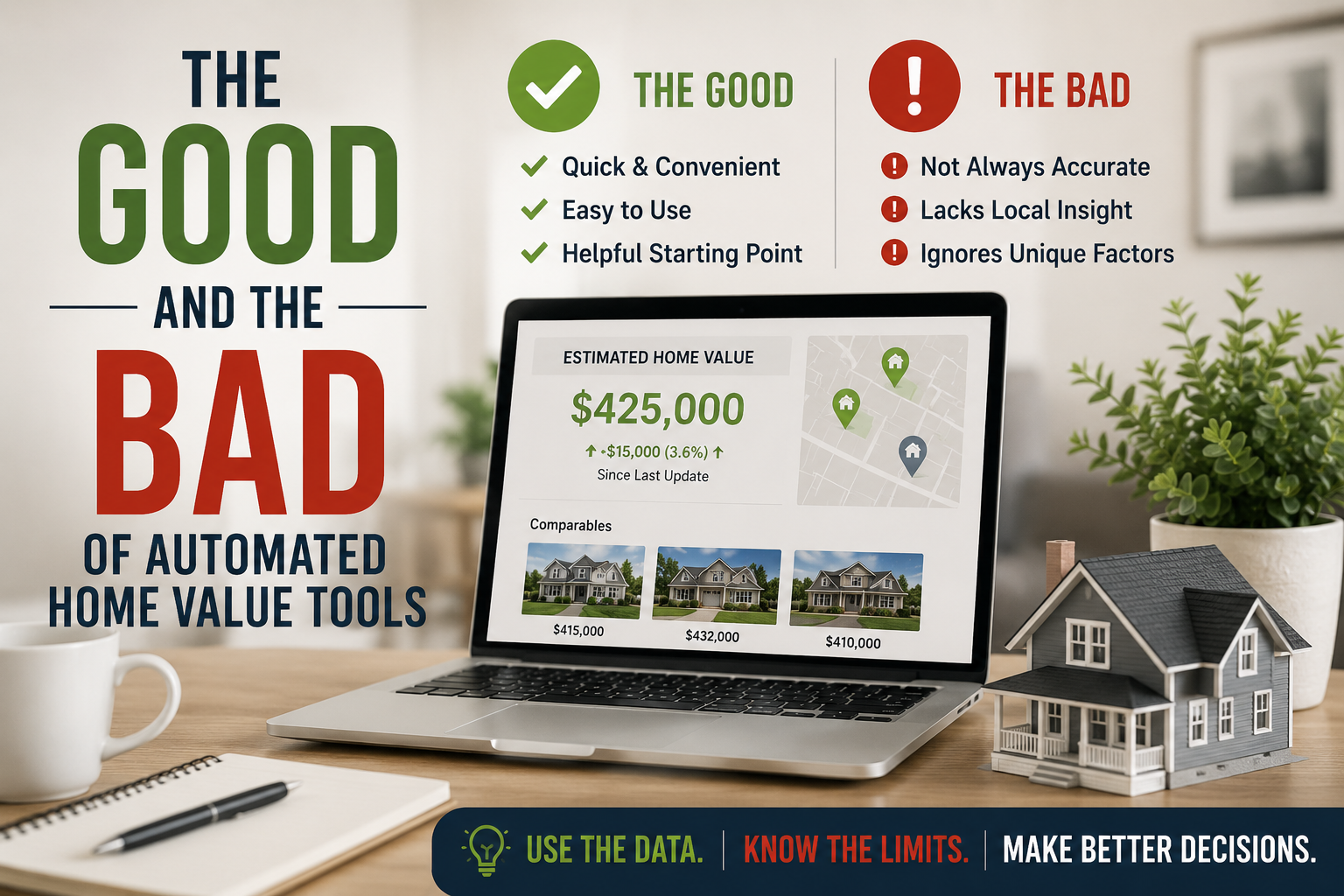
The Good: What Automated Home Value Tools Do Well
Despite their limitations, automated home value tools offer real benefits — especially when used appropriately as a starting point rather than a final answer.
They provide a quick ballpark estimate. If you’re casually curious about what your home might be worth, or you’re just beginning to research a neighborhood before a move, AVMs give you an instant, rough idea of the price range without any commitment. They’re a great way to start a conversation.
They’re useful for tracking trends over time. Checking the same tool repeatedly over months or years can give you a general sense of whether values in a given area are rising or falling. Even if the exact number is off, the directional trend can be informative.
They offer broad market context. Automated home value tools can help buyers compare general price levels across different neighborhoods or zip codes, making it easier to narrow down where to focus a home search before diving into specific listings.
They’re always available. Whether it’s 2 p.m. on a Tuesday or midnight on a Sunday, you can pull up an AVM estimate instantly. For late-night research sessions, that convenience is genuinely valuable.
The Bad: Where Automated Home Value Tools Fall Short
Here’s the hard truth: automated home value tools can be wildly inaccurate — and the consequences of trusting them too much can be costly. Here’s where they consistently struggle.
They can’t see inside the home. An algorithm has no way of knowing whether your kitchen was gut-renovated last year or hasn’t been touched since 1987. It doesn’t know if your bathroom has heated floors and a soaking tub, or pink tile from the 1960s. These interior conditions have enormous impact on value, and AVMs simply cannot account for them.
They rely on potentially outdated or incomplete data. AVMs depend on public records, which are often lagging or inaccurate. A home’s square footage might be listed incorrectly in county records, or a recently added bedroom may not yet be reflected in the tax database. Garbage in, garbage out — and the estimate suffers accordingly.
They struggle in unique or low-turnover neighborhoods. AVM accuracy depends heavily on the availability of comparable sales data. In neighborhoods where homes rarely change hands, or where properties are highly unique (custom-built homes, large lots, unusual floor plans), there simply aren’t enough true comparables for the algorithm to work with. Estimates in these areas can be off by tens of thousands of dollars — or more.
They don’t account for hyperlocal factors. A street can change dramatically from one block to the next — in terms of noise, views, traffic, school attendance zones, and proximity to amenities. Automated home value tools work at too broad a scale to factor in these nuances, which a local real estate agent would immediately recognize.
The error margins are significant. Zillow itself publishes its median error rate, which for off-market homes has historically hovered around 6–7% nationally — and can be much higher in certain markets or property types. On a $400,000 home, a 7% error means the estimate could be off by $28,000 in either direction. That’s a meaningful sum when negotiating a purchase or setting a list price.
Find Your Home’s Current Value Here!
Why Automated Home Value Tools Struggle in Greater Cincinnati
The Greater Cincinnati real estate market is particularly tricky for automated home value tools because of how dramatically home values vary across short distances. A home in Hyde Park and a home three miles away in another neighborhood might look similar on paper but carry very different market values based on school district, walkability, and buyer demand.
Cincinnati also has a high proportion of older homes with unique architectural features, finished basements, additions, and renovations that don’t always get captured in public records. This means AVMs in the Cincinnati area may be working with incomplete or misleading data more often than in markets with newer, more uniform housing stock.
Similarly, Northern Kentucky communities like Covington, Florence, and Union each have their own market dynamics that an algorithm trained on national data may not fully understand. Local expertise matters here more than almost anywhere.
The Bottom Line on Automated Home Value Tools
Automated home value tools are a fine starting point — but a dangerous ending point. Use them the way you’d use a weather app: helpful for a general sense of conditions, but not something you’d stake a major decision on without more information.
If you’re buying a home, don’t let a Zestimate dictate what you offer. A licensed appraiser and a knowledgeable buyer’s agent will give you a far more accurate picture. If you’re selling, don’t price your home based on what an algorithm says — work with a local real estate professional who can run a proper comparative market analysis using real, recent, verified sales data.
Automated home value tools are a useful part of the modern real estate landscape, but they work best as one data point among many — not as the final word on what your home is worth. When real money is on the line, there’s no substitute for local knowledge and professional expertise.
Find Your Home’s Current Value Here!